

Preserving cultural heritage: Conservators offer an insight into their work
News from 09/24/2026
Since 2021, seven German museums, led by the Central Archives of the Berlin State Museums, have been conducting research into the ‘Boxer Rebellion’ – and the provenance researchers are now publishing a guide for museum professionals, collectors and decision-makers
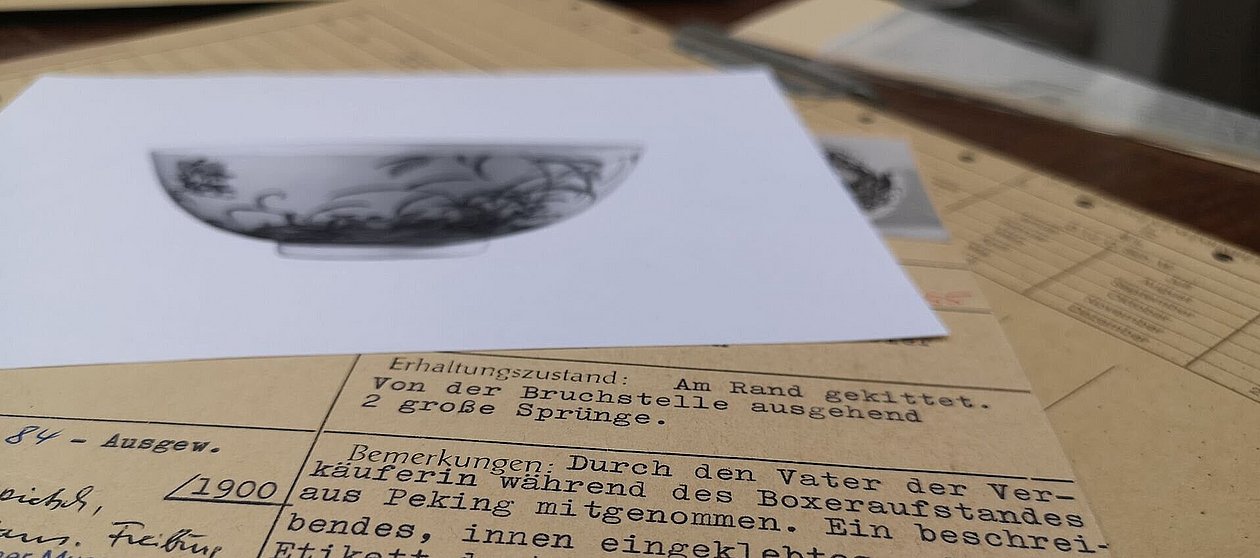
The newly published guide to identifying looted artefacts from the ‘Boxer Rebellion’ offers practical guidance on provenance research for Chinese objects created before 1900. It will be presented on 25 September 2026 at the Humboldt Forum in Berlin.
During the so-called ‘Boxer Rebellion’ in China (1900–1901), there were not only brutal acts of war and ‘punitive expeditions’. There was also widespread looting of imperial palaces, temples, shops, public institutions and private homes in Beijing and northern China. Any collection containing Chinese objects from the period before 1900 may include such looted artefacts. To date, in-depth research into this topic has been rare. As part of the German-Chinese collaborative project ‘Traces of the “Boxer War” in German museum collections – a joint approach’, a comprehensive framework has now been established for this purpose: Under the leadership of the Central Archive of the State Museums in Berlin, seven German museums, in collaboration with Chinese partner institutions, have drawn up a research guide. ‘Tracing Loot from the “Boxer War” in China. A Research Guide for Public and Private Collections’ has been published by the German Centre for Lost Cultural Property.
Marion Ackermann, President of the Prussian Cultural Heritage Foundation, says: “The new guide is an important practical aid for provenance research into Chinese objects worldwide – and at the same time, it is a great success of this collaborative project that it has brought the brutal Boxer War and its consequences back into public consciousness.”
The ‘Boxer War’ is a little-known colonial war in which the German Empire was also involved. Following the Opium Wars, the major European powers, Japan and Russia increasingly secured influence in China. This was opposed by the anti-imperialist Yihetuan movement, whose members were referred to in the West as ‘Boxers’ due to their martial arts. In 1900, a military coalition known as the Eight-Nation Alliance – comprising the United Kingdom, France, the USA, Austria-Hungary, Italy, Japan and Russia, sent troops to China to crush the Yihetuan uprising. In the aftermath, for almost a year, there were not only brutal acts of war and ‘punitive expeditions’, but also widespread looting of imperial palaces, temples, shops, public institutions and private households in Beijing and northern China. Porcelain, bronzes, scroll paintings, religious artefacts, weapons, books and other items found their way into public and private collections worldwide, either directly or via the art trade. To date, their provenance has been researched in only a very few cases.
Since 2021, seven German museums, led by the Central Archive of the Berlin State Museums, have been conducting research into the ‘Boxer War’: the Museum of Asian Art and the Ethnological Museum of the Berlin State Museums; the Museum am Rothenbaum: Cultures and Arts of the World and the Museum of Arts and Crafts in Hamburg; the GRASSI Museum of Applied Arts in Leipzig; the Museum of Applied Arts in Frankfurt am Main; and the Museum Fünf Kontinente in Munich. The collaborative project was carried out in close cooperation with the Palace Museum in Beijing and funded by the German Centre for Lost Cultural Property. The German partners in the consortium are:
The guide (174 pages, in English) is aimed at museum professionals, collectors and decision-makers. It provides an introduction to the ‘Boxer Rebellion’ and the locations, key figures and mechanisms involved in the looting. For researching the provenance of a museum’s own collections, it outlines a three-step approach and presents ten exemplary case studies from German museums. A comprehensive appendix provides essential material for research, including a chronology, a list of sites of looting, maps, an archive guide and a bibliography.